It's a question that comes up in every solar and energy-efficiency group sooner or later.
Your panels are pumping out more power than you can use in the middle of the day. Or you've signed up for one of the new free midday electricity plans. Your heat pump hot water system has an electric boost element built in. So why can't you just set that element to switch on every day at noon and soak up the free power?
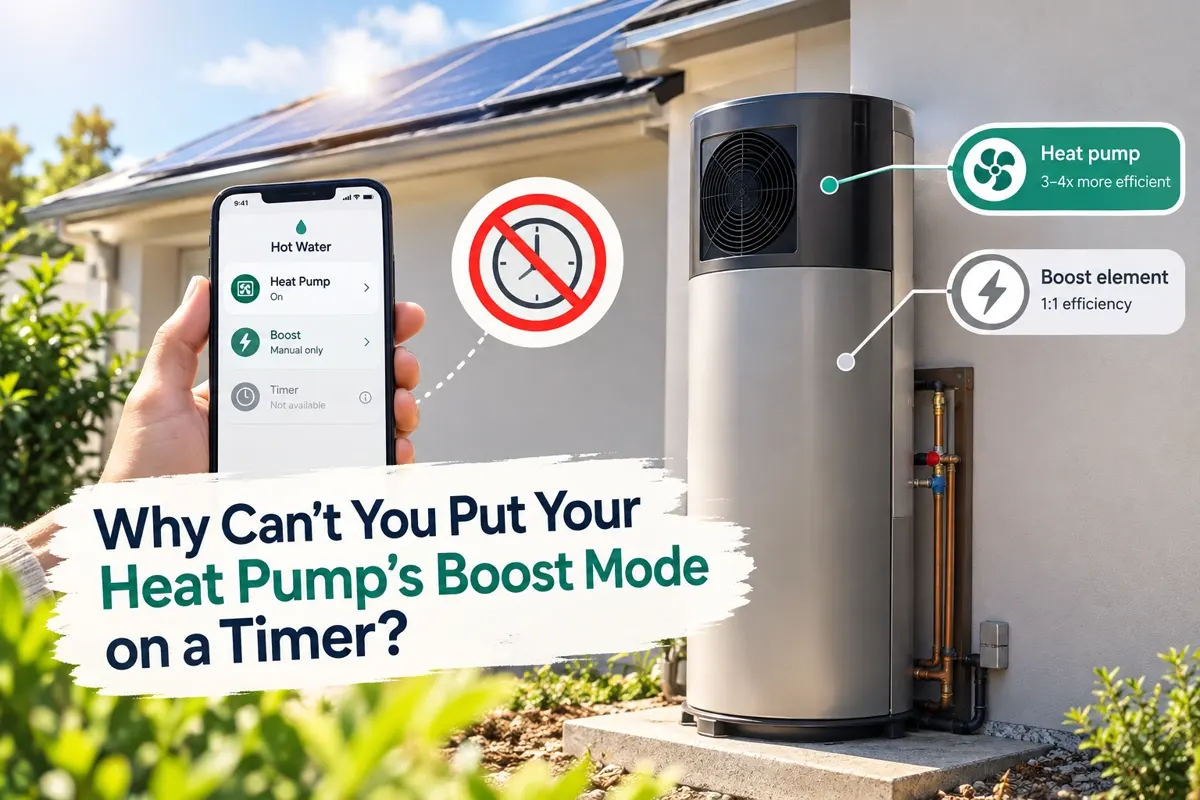
On many heat pumps, you turn on boost by pressing a button on the unit. Many also let you trigger a one-shot boost from the app. Either way, it's a one-off. There's no timer and no daily schedule, so you have to remember to do it every single day.
It isn't an oversight. Here's why manufacturers do it, and what you can do instead.
What the boost element actually is
Most heat pump hot water systems in Australia have two ways to heat water (our heat pump buying guide covers the basics in more detail):
- The heat pump (compressor). This pulls heat from the surrounding air and moves it into the water. It's the efficient part, typically delivering around 3 to 4 units of heat for every unit of electricity it uses.
- The boost (backup) element. This is a plain electric resistance element, like the one in an old-style electric storage tank. It turns 1 unit of electricity into 1 unit of heat. That's it.
The element is there as a safety net. It helps on very cold mornings, after a big run of showers, if the compressor develops a fault, or during a periodic high-temperature cycle to keep the tank hygienic.
It was never designed to be the main way the tank gets heated.
Why manufacturers won't let you schedule it
1. The system is certified to run as a heat pump
Heat pump hot water systems qualify for Small-scale Technology Certificates (STCs), the federal rebate, because they are registered with the Clean Energy Regulator based on how they perform as a heat pump.
The number of STCs a system earns is tied to how much energy it saves compared to a conventional electric water heater. If owners could easily switch the element on every day, the unit would behave a lot more like the old electric tank it was meant to replace.
That's why many manufacturers keep the element locked down to automatic backup use and a manual, one-off boost. A daily boost timer would undercut the basis on which the product was certified and subsidised. State schemes that offer extra incentives for heat pumps work on the same logic.
2. It protects the efficiency the product is sold on
Heat pumps are marketed on low running costs. If the element runs on a schedule, especially if someone sets that schedule wrong and it kicks in at night on grid power, running costs can triple overnight.
Manufacturers would rather not field those complaints, so they keep boost as a deliberate, one-off action.
3. Simple controllers
Plenty of heat pump controllers and Wi-Fi apps are quite basic. They'll let you set a timer for the compressor, change the target temperature and, on many models, trigger a one-shot boost from your phone. Scheduling the element as a separate, recurring task is simply not a feature on most units.
"But I only want to use surplus solar, and save wear on the compressor"
That's a fair idea, and it's usually the reason people ask. But the maths and the mechanics don't really support it.
The element uses your solar far less efficiently. A 1 kW heat pump compressor can put roughly 3 to 4 kW worth of heat into your tank. The element puts in 1 kW of heat for 1 kW of power. Even when the solar is "free", you'd be heating the same water with three to four times the energy, energy you could otherwise be exporting or using elsewhere.
Compressor wear isn't the problem people think it is. A heat pump that heats the tank once a day, in the warmest part of the day, is running in its easiest conditions. Short, frequent cycling and cold-weather running are harder on a compressor than one steady daytime run. Using the element to "rest" the compressor gives you very little in return.
What about free midday electricity plans?
Solar isn't the only way to get cheap daytime power any more. New government-backed plans give households 3 hours of free electricity in the middle of the day:
- Solar Sharer Offer (NSW, South Australia and South East Queensland). Available from 1 July 2026. Eligible households get up to 24 kWh of free electricity during a 3-hour midday window each day. The exact hours are set for each area.
- Victorian Midday Power Saver (Victoria). Available from 1 October 2026. It gives households free electricity from 11am to 2pm, up to 24 kWh a day.
You don't need rooftop solar to join either plan, but you do need a smart meter, and you sign up through your electricity retailer. You still pay your daily supply charge and for power used outside the free window, and those rates may be higher, so compare carefully.
Naturally, plenty of homeowners are now asking whether they can put their heat pump on boost during the free window. You can, but only as a one-off. You'll still need to press boost on the unit or in the app each day, because the timer limits above still apply.
The better option is to set the heat pump's own timer to run inside the free window. The compressor can heat a full tank for free, using only a fraction of your 24 kWh allowance. That leaves the rest for other appliances like the washing machine, dishwasher, pool pump or EV charger. Try to stagger big appliances across the 3 hours rather than running them all at once.
What works better
If your goal is to heat your water with your own solar or free midday power, you have better options than scheduling the boost element.
Set the heat pump's timer to your solar or free power window
This is the simplest and most effective fix. Most heat pumps let you set the compressor to run during set hours. Set it to run from around 10am to 3pm on solar, or inside your plan's free 3-hour window, and it will heat the tank almost entirely on free power, at 3 to 4 times the efficiency of the element.
Use one-shot boost from the app when you really need it
If you've got guests staying or the tank's run low, a one-shot boost from the app during the middle of the day is a sensible top-up. Just treat it as an occasional extra, not a daily routine.
Raise the target temperature during the day
Where your model allows it, heating the tank a little hotter during solar or free hours stores more of that energy as hot water for the evening. Always keep the delivery temperature at the tap within safe limits. Your installer can check that a tempering valve is fitted.
Use a solar diverter, but with the right tank
Solar diverters, which send surplus solar to a resistive element, work well with a standard electric storage tank. They're not designed for heat pumps, and using one on a heat pump's backup element runs into the same certification issues above.
The bottom line
You can't put boost mode on a timer because the boost element is a backup, not a feature. Your heat pump is certified, subsidised and designed to heat water with the compressor, and manufacturers lock the element down to protect that.
The good news is you don't need the element to make the most of your solar or a free midday power plan. Setting the heat pump to run during the day does the same job with a fraction of the energy, and keeps your warranty intact.
If you're choosing a new system and want one that works well with rooftop solar or a free power window, compare timer options and app features before you buy. You can see how our quote process works to compare options from local installers.
Get 3 free heat pump quotesfrom local installers and ask which models suit your home.