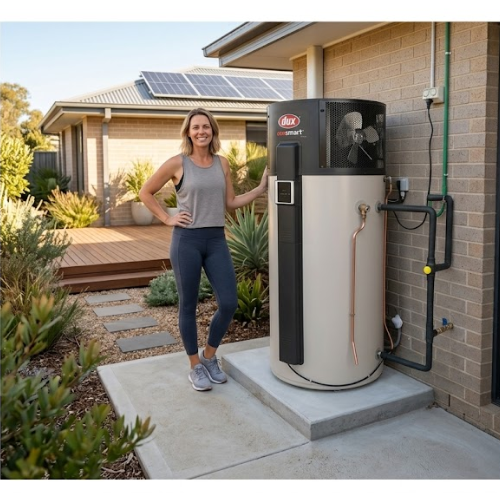
What Does A Heat Pump Hot Water System Cost, Installed?
Once you include the federal rebate that applies automatically at point of sale, a fully installed heat pump hot water system typically comes in somewhere around $4,000 to $4,800 for most Australian households, with the number shifting depending on where you live. Regional and less densely serviced markets (Tasmania is the standout example) tend to sit noticeably higher, largely because fewer installers cover the area and freight adds to the cost. If you're in a state that layers its own rebate on top of the federal one, your out-of-pocket cost can drop well below that in some cases to around $2,600–$4,000, depending on what system you're replacing.
At the premium end, CO2-refrigerant systems (the most efficient and best cold-weather performers) tend to land around $5,500 to $6,500 installed. Budget units using older refrigerant can come in under $3,500 in well-serviced metro areas.
Hardware vs installation. Where the money actually goes
It helps to think of the total price as two separate line items:
The unit itself typically ranges from around $2,000 for a solid mid-range tank under 200L, up to $2,500–$3,500 for larger, well-known-brand units in the 250–300L range, and $5,000–$6,000+ for top-tier premium models.
Installation is usually the cheaper half of the bill. A simple swap — reusing your existing electrical circuit, no new gas-to-electric conversion — can come in as low as $600–$800, since in some cases a plumber with the right restricted electrical licence can complete the whole job without needing a separate electrician. Converting from gas, which needs a brand-new circuit run from the switchboard plus both a licensed plumber and electrician, typically starts from $1,000–$1,400.
Installation costs climb further if the job needs:
- A heat pump relocated somewhere new, requiring fresh water lines
- A switchboard more than about 10 metres from the install location
- Difficult site access requiring specialised lifting equipment
- Removal and disposal of an old gas or solar system
Worth asking your installer for: the unit price and the installation cost broken out separately, plus photos-based quoting so the price you're given is genuinely fixed rather than an estimate that grows once they're on site.
Beware Of Unusually Cheap Quotes
The technology has a rebate attached to it, which unfortunately also attracts operators looking to squeeze a fast, corner-cutting install out of the incentive. If a quote comes in well below the typical mid-$3,000s-to-low-$4,000s range for a basic installation, it's worth asking exactly what's being skipped. Pipe insulation, proper base support, and correct sacrificial anode access are the things that get cut first, and all three affect either your running costs or your warranty down the track.
How Rebates Bring The Price Down
Federal STCs. Every heat pump hot water system installed in Australia earns Small-scale Technology Certificates (STCs), with the number depending on the unit's efficiency and which climate zone you're in. Installers deduct the value of these certificates directly from your quote — you don't claim it separately afterwards — so the price you're shown is normally already net of this discount. The dollar value moves with the certificate's trading price, so it's not a fixed number, but for a typical 200–315L unit it generally works out to somewhere in the low hundreds of dollars.
State-level rebates. Some states stack an additional rebate on top of the federal STC discount. Victoria, for example, offers a flat contribution toward eligible systems (with a higher amount for Australian-made units), plus a separate energy-efficiency-certificate style rebate depending on what you're replacing. NSW runs its own hot water upgrade incentive with a minimum co-payment requirement designed to stop "too good to be true" free-install offers. These programs come with eligibility conditions. Household income caps, property value limits, minimum age of the system being replaced. So it's worth checking the current rules for your state rather than assuming you qualify.
Not every state currently has a stacking rebate on offer, so in some parts of the country the federal STC discount is the only one you'll see applied.
Running Costs: What You'll Actually Save
This is where heat pumps earn their keep. The key figure is COP coefficient of performance which tells you how many units of heat a system delivers for every unit of electricity it consumes. A standard resistive electric tank sits at a COP of around 1.0: one unit of heat out for each unit of power in. A decent heat pump typically runs at a COP of 3 to 4, meaning it can produce three to four times as much heat from the same amount of electricity.
That translates to a real difference on your bill: a heat pump usually costs somewhere around $150 to $300 a year to run, against roughly $450 to $900 a year for an old-style resistive electric tank covering the same household.
One thing worth knowing: the COP figure quoted by manufacturers is usually measured at a mild air temperature. On a genuinely cold morning, actual performance drops sometimes noticeably which is why it's worth asking for cold-weather performance figures if you live somewhere that gets properly cold. CO2 and propane (R290) refrigerant systems generally hold their efficiency better in low temperatures than older R134A units.
If you already have solar panels, timing the heat pump to run during daylight hours (most units include a timer, or one can be added) means the compressor draws mostly free solar power instead of grid electricity, pushing running costs even lower the tank itself acts like a thermal battery, holding that heat overnight for the next morning's shower.
Payback Period
Because a heat pump typically costs more upfront than the resistive or gas system it's replacing, but saves substantially on running costs, most households recoup that price difference within roughly 1.5 to 5 years, depending on household hot water usage, local electricity or gas prices, and whether you have solar to run it on. After that, it's straightforwardly cheaper to run for the rest of its working life.
Paybacks tend to be shortest for:
- Larger households with higher daily hot water use
- Homes replacing an old resistive electric tank rather than gas
- Homes on higher electricity tariffs
- Homes that can time the heat pump to run on daytime solar
Choosing The Right Size (And Why It Affects Price)
Tank size is one of the biggest levers on price, so it's worth sizing correctly rather than defaulting to the biggest unit available. A rough rule of thumb is about 50 liters of capacity per person in the household:
- 1–2 people: around 150–180L is usually plenty
- 3–4 people: most households land on 250–270L
- 5+ people: step up to 300–315L, and don't go smaller
- Large households or heavy hot water use: the largest residential units go up to around 400L
Under sizing means running out of hot water on busy mornings; oversizing means paying for both capacity and running costs you don't need.
Other Things That Affect Long-Term Cost
- Noise. Heat pump compressors typically run somewhere between 35 and 55 decibels at a meter. Roughly comparable to a window air conditioner. It's not usually a problem, but worth thinking about if the unit has to go near a bedroom window.
- Warranty. Coverage varies a lot by brand, and the tank and compressor are often covered separately. Look for at least 5–7 years on the compressor and closer to 10 years on the tank a headline "10-year warranty" that only applies to the tank, with just 2–3 years on the compressor, is worth reading the fine print on.
- Servicing. Most manufacturers recommend a periodic professional check to keep the unit running efficiently and to protect the warranty.
- Sacrificial anode. Like any hot water tank, heat pumps rely on a sacrificial anode to prevent tank corrosion. Normal maintenance, not a fault.
- Removing your old system. If you're replacing a gas system, factor in the cost of safely disconnecting and removing it, which some installers include in their quote and others charge separately.
Getting An Accurate Price For Your Home
Every one of these figures is a range because the real cost depends on your household size, your existing setup, and where you live. The only way to get an accurate number is to have a licensed installer assess your specific situation.
Get 3 free quotes to compare real prices from vetted local installers, so you know exactly what you'll pay before you commit.
Get 3 free quotes