The Simple Version
Think of a heat pump hot water system as a fridge working in reverse. A fridge pulls heat out of the inside of the box and dumps it into the room behind it (that's why the back of your fridge feels warm). A heat pump hot water system does the opposite. It pulls heat out of the outside air and pumps it into your water tank.
Step By Step
- 1
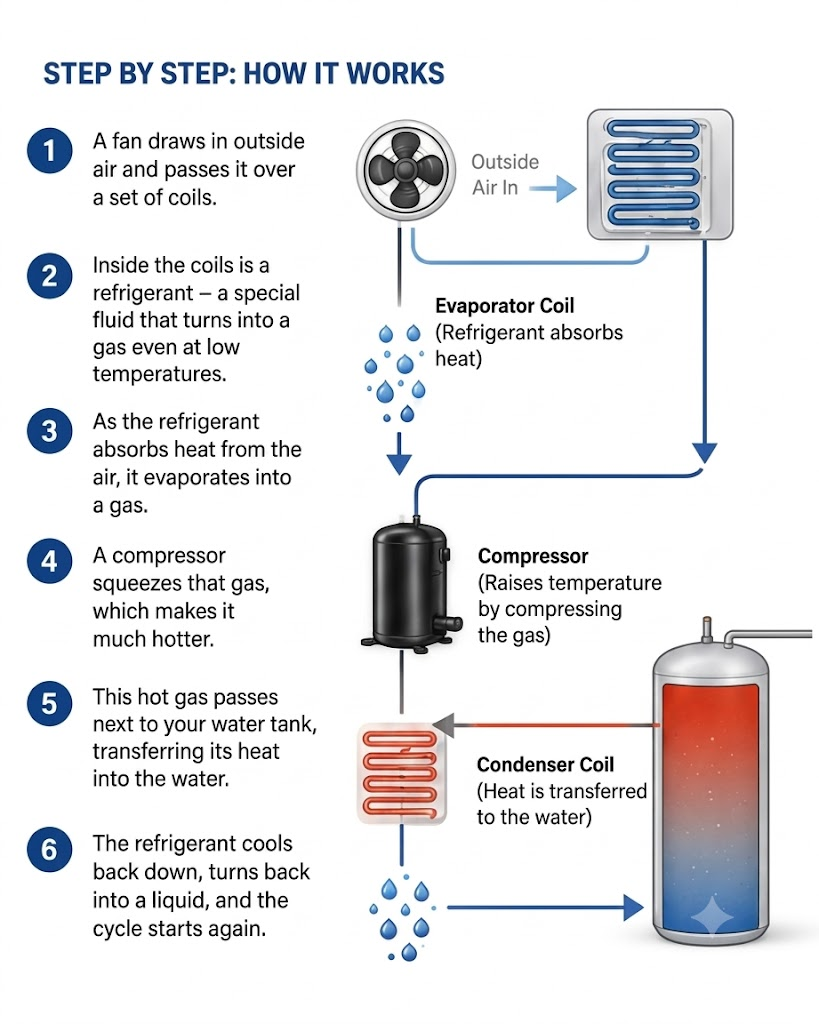
A fan draws in outside air and passes it over a set of coils
- 2
Inside the coils is a refrigerant — a special fluid that turns into a gas even at low temperatures
- 3
As the refrigerant absorbs heat from the air, it evaporates into a gas
- 4
A compressor squeezes that gas, which makes it much hotter
- 5
This hot gas passes next to your water tank, transferring its heat into the water
- 6
The refrigerant cools back down, turns back into a liquid, and the cycle starts again
The whole process uses a small amount of electricity to run the fan and compressor — but the actual heat mostly comes free from the air around it. That's the whole secret to why heat pumps are so much cheaper to run.
Do Heat Pumps Work In Winter Or Cold Areas?
Yes. Modern heat pumps are designed to keep working even when the outside air is cold, because there's still enough warmth in the air for them to extract, right down to temperatures well below freezing. In very cold regions, some models use a booster electric element for extremely cold days, but for most of Australia this is rarely needed.
All-In-One vs Split System Heat Pumps
All-in-one
the tank and heat pump unit sit together as a single unit, usually outside. Simpler to install, takes up one spot
Split system
the heat pump unit is separate from the tank, connected by pipes. Useful when space near the tank is tight, often quieter
What's Actually Inside The Unit?
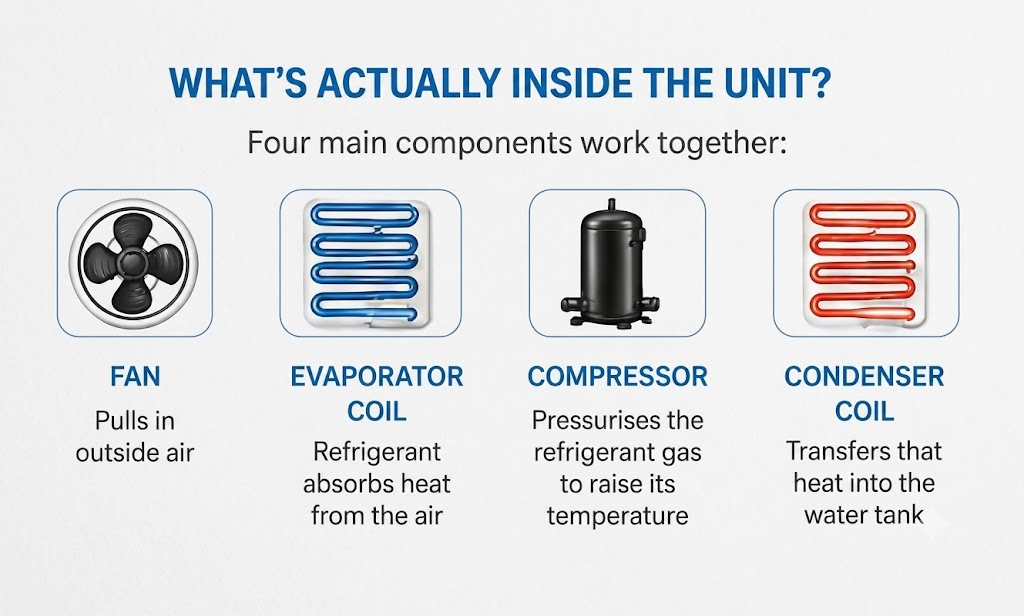
If you were to open up a heat pump hot water unit, you'd find four main components working together: a fan (to pull in outside air), an evaporator coil (where the refrigerant absorbs heat), a compressor (which pressurizes the refrigerant gas to raise its temperature), and a condenser coil (which transfers that heat into the water tank). None of these parts are unusual or experimental. They're the same basic components used in fridges, freezers, and air conditioners, which is part of why the technology is so reliable.
How Much Electricity Does It Actually Use?
A heat pump still needs electricity. It's not completely free to run. But because it's moving existing heat rather than generating it from scratch, it typically produces three to four units of heat energy for every one unit of electricity it consumes. Compare that to a standard electric element, which produces roughly one unit of heat for every one unit of electricity. No more, no less, since it can't 'cheat' the laws of physics the way a heat pump can.
Do You Need Anything Special Installed?
Generally, no. Heat pump hot water units connect to a standard household power point or circuit (your installer will confirm this based on the model) and to your existing plumbing, the same way a standard electric or gas system would. The main practical requirement is a location with reasonable airflow. The unit needs to draw in and release air freely, so it shouldn't be boxed into a tight, enclosed space.
A Simple Way To Picture It
If you've ever felt the warm air blowing out the back of a running fridge, or stood near an air conditioner's outdoor unit and felt it exhale cooler or warmer air, you've already experienced the same principle a heat pump hot water system uses. Just applied to warming your water instead of cooling your kitchen or your lounge room.
Ready to compare systems?
Get a recommendation based on your household size, location, and existing hot water setup.