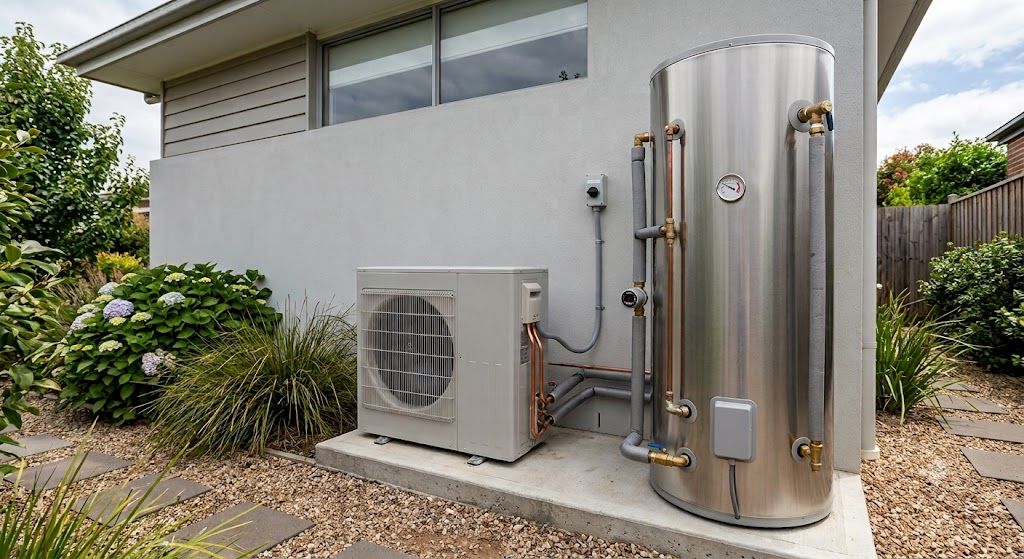
The Federal Rebate: Small-scale Technology Certificates (STCs)
Every heat pump hot water system installed in Australia qualifies for Small-scale Technology Certificates (STCs) under the federal Small-scale Renewable Energy Scheme. This is the baseline discount available regardless of which state you live in.
Here's how it actually works in practice:
- Your installer creates the certificates at the point of installation, based on how much energy your new system is expected to displace over its "deeming period" (the number of years the scheme still credits it for).
- Those certificates get sold to a registered agent, and the value comes straight off your quoted price.
- You don't fill in any forms or wait for a rebate cheque. The discount is already baked into the price your installer quotes you.
Typical value: somewhere between $400 and $1,200, depending on:
- Your STC zone → Australia is split into climate zones, and homes in cooler zones generate more certificates than homes in warmer ones, since a heat pump displaces more energy use in the cold
- The size and efficiency of the unit you choose
- The current STC market price → this fluctuates like any traded certificate, and has been sitting around the high-$30s per certificate recently
One thing worth knowing: the deeming period drops by a year every January 1st, and the whole scheme is legislated to wind down by 2030. In practice, that means the same system typically earns a slightly smaller STC discount if you install it a year later rather than now. It's a gently shrinking incentive, not a stable one.
What to do: ask your installer to show the STC value as its own line item on the quote, rather than accepting a vague "rebate included" that way you can actually see what you're getting.
State-Level Rebates (Stack On Top Of STCs)
Several states run their own energy-efficiency schemes that can be combined with the federal STC discount for a bigger total saving. Not every state has one currently, so check what applies in yours.
Victoria — Victorian Energy Upgrades (VEU) / Solar Victoria
Victoria runs the most active state-level program for heat pump hot water. Depending on which specific pathway applies to your upgrade:
- The VEU program typically provides an additional $700 to $1,000+ for eligible upgrades replacing an old gas or electric storage system, on top of the STC discount
- Solar Victoria's rebate covers a similar space, offering up to $1,000 to $1,400 for eligible households replacing a system that's at least three years old
Combined with STCs, Victorian households often see a total saving in the $1,500 to $2,200+ range.
New South Wales — Energy Security Safeguard (ESS)
NSW runs its own certificate scheme (ESS) that stacks with the federal STC discount, with combined savings often landing around $900 to $1,350 on a typical electric-tank replacement.
One important detail: standard NSW jobs carry a mandatory minimum co-payment. This exists specifically to stop "too good to be true" fully free installs, so don't expect the incentive to cover 100% of the cost. There's also a specific gas-to-heat-pump household activity under the NSW scheme that's time-limited, so it's worth checking the current rules with your installer rather than assuming older information still applies.
South Australia — REPS + Council Rebates
South Australia's support is more fragmented but can still add up:
- REPS (Retailer Energy Productivity Scheme) rebates are available through your energy retailer
- Some councils — Adelaide City Council among them — offer their own rebate, up to $1,000, for replacing an electric resistance system with a heat pump
Stacked together with STCs, some SA households have brought their effective cost down to somewhere in the $1,500 to $3,000 range, though availability varies by council and can be patchy.
Western Australia & Queensland
WA currently doesn't have a broad state-wide rebate on top of the federal STC discount, for most WA households, the STC value is the only incentive available. Queensland has had certificate-style schemes come and go; check current availability with your installer rather than assuming a program is still running.
A Realistic Summary
| State | Federal STC | State top-up | Typical combined saving |
|---|---|---|---|
| VIC | $400–$1,200 | $700–$1,400 | $1,500–$2,200+ |
| NSW | $400–$1,200 | Varies (co-payment applies) | $900–$1,350 |
| SA | $400–$1,200 | Up to $1,000 (council-dependent) | $1,500–$3,000 |
| WA | $400–$1,200 | None currently | $400–$1,200 |
| QLD | $400–$1,200 | Varies / check current status | $400–$1,200+ |
These are indicative ranges, not guarantees — your exact figure depends on your postcode, your existing system, and the specific unit you choose.
Who Actually Gets The Best Value From These Rebates?
- Households replacing an old electric storage system tend to see the strongest combined savings, especially if they also have solar or sit on a higher electricity tariff
- Very low hot-water-use households or renters without landlord approval tend to see less benefit relative to the upfront cost, since the running-cost savings that make the switch worthwhile take longer to add up
- Households in cooler climate zones generally see a larger STC discount than those in warmer zones, since the modelled energy savings are higher
How To Actually Claim These Rebates
The good news: in almost every case, you don't personally submit any paperwork. Your installer handles the certificate creation and paperwork for both the federal STC scheme and most state programs, and the value is simply reflected as a lower number on your quote.
What you should do:
- 1Get quotes from a few installers and ask each one to itemise the STC value and any state rebate value separately, rather than accepting a single bundled "rebate included" figure
- 2Confirm your existing system is eligible -> most programs require you to be replacing an electric or gas system, not upgrading from an existing heat pump
- 3Check current eligibility rules for your state before assuming an older article or quote still applies, since several of these programs have time limits, co-payment rules, or council-specific conditions that shift over time
A Word Of Caution
Because rebates lower the visible price, they can also attract installers looking to cut corners to make a "too good to be true" offer work. If a quote seems dramatically cheaper than everything else you're seeing, it's worth asking directly what's being skipped. Proper pipe insulation, correct base support, and full compliance paperwork are the first things that tend to disappear from bargain-basement installs.
Get An Accurate Number For Your Home
Every figure above is a range, because the real number depends on your postcode, your existing system, and which unit you choose. The only way to know exactly what you'll pay after rebates is to get quotes from licensed local installers who can apply the current STC and state rebate values to your specific situation.
Get 3 free quotesRebate programs and values change over time. The figures on this page reflect current programs as of mid-2026. Always confirm the exact current value with your installer before making a decision.